
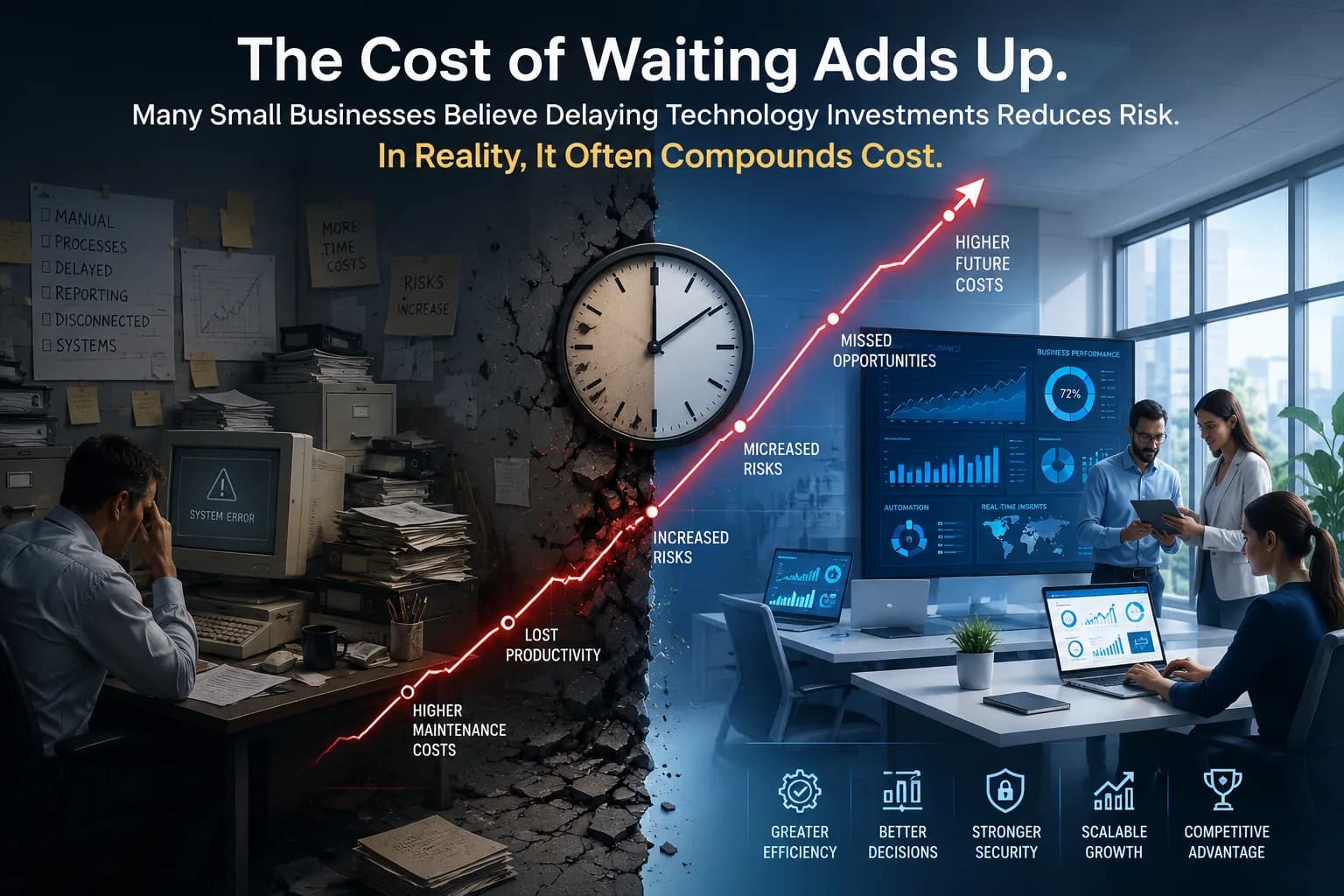
Many Small Businesses Believe Delaying Technology Investments Reduces Risk. In Reality, It Often Compounds Cost.
For many small businesses, delaying technology investments can feel like the safest financial decision. Budgets are tight, priorities compete for attention, and existing systems may appear "good enough" to support day-to-day operations.
But while postponing modernization may reduce short-term spending, it often increases long-term operational and financial costs.
Outdated systems frequently create inefficiencies that are easy to overlook at first — manual processes, disconnected data, duplicate work, and slower decision-making. Over time, these inefficiencies compound and begin impacting productivity, customer experience, scalability, and overall business agility.
The hidden cost becomes even greater as businesses grow. Legacy platforms are typically more difficult and expensive to integrate, maintain, and secure. What may have started as a cost-saving measure can eventually lead to larger migration projects, increased technical debt, and greater operational disruption in the future.
There is also a competitive impact. Organizations that adopt modern technologies earlier are often better positioned to leverage automation, improve customer engagement, gain real-time insights, and adapt more quickly to market changes. Businesses that delay transformation risk falling behind competitors that are building more efficient and scalable operations.
Technology investments should not simply be viewed as IT expenses. When approached strategically, they can enable growth, improve operational resilience, and reduce total cost of ownership over time.
Modernization does not always require large-scale transformation overnight. Incremental, well-planned investments aligned to business priorities can help organizations reduce risk while positioning themselves for long-term success.
In today's environment, the question is no longer whether businesses can afford to modernize — it is whether they can afford to wait.