
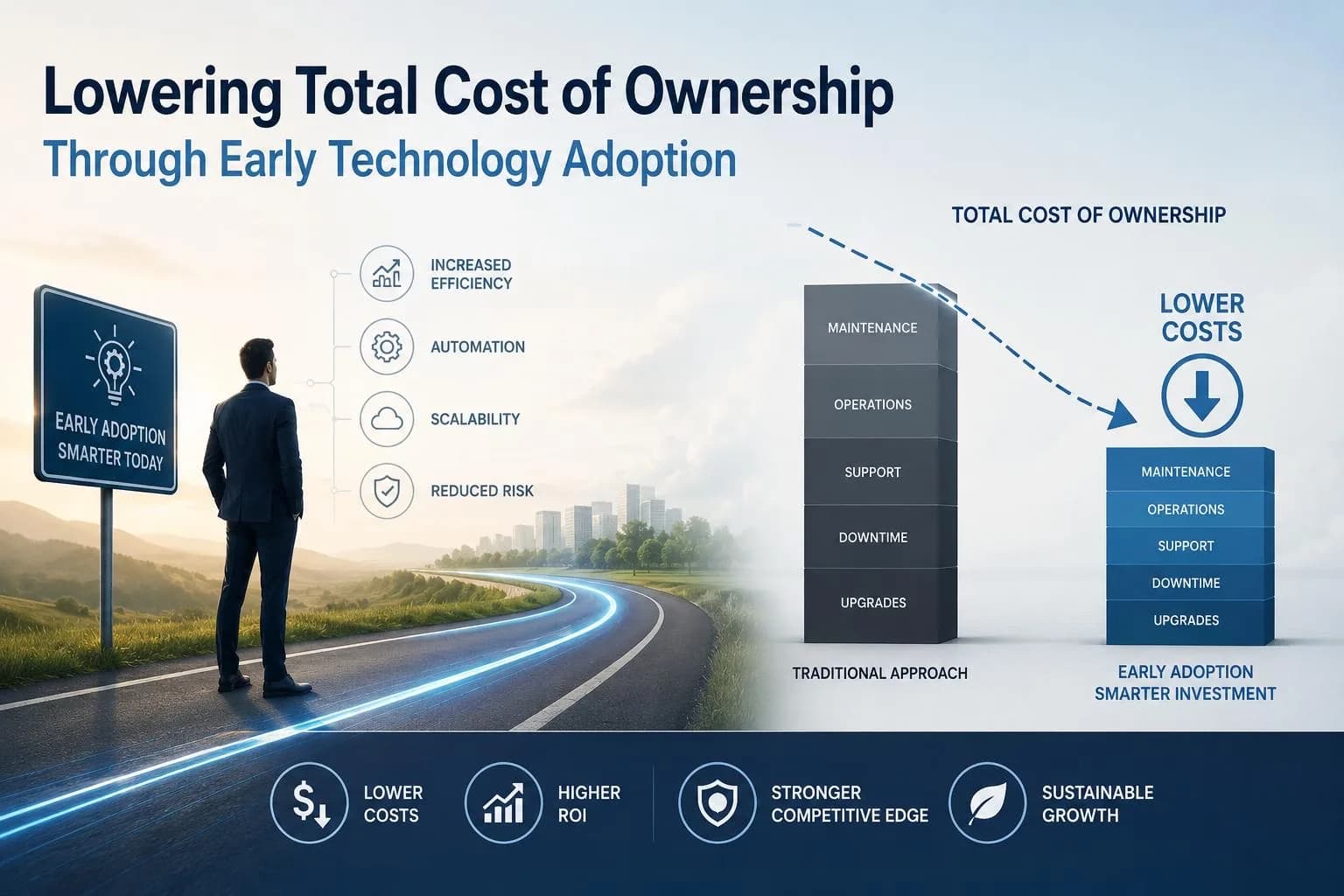
Lowering Total Cost of Ownership Through Early Technology Adoption
Emerging biotech companies are under increasing pressure to scale efficiently while maintaining regulatory readiness, operational agility, and financial discipline. As organizations move from early clinical stages toward commercialization, many delay investments in technology platforms and process automation in an effort to conserve capital. However, evidence increasingly shows that companies adopting scalable, compliant technologies earlier in their growth journey often achieve a significantly lower long-term total cost of ownership (TCO) while improving operational performance and reducing compliance risk.
Manual processes, disconnected spreadsheets, and fragmented systems may appear manageable in early stages, but they frequently create operational bottlenecks as organizations grow. As clinical programs expand and regulatory scrutiny increases, these disconnected environments often require costly remediation, revalidation efforts, data reconciliation, and process redesign. In many cases, the expense of fixing outdated or heavily customized legacy processes far exceeds the cost of implementing scalable digital platforms earlier.
Industry research highlights the measurable value of early automation and standardization. Studies have shown that organizations leveraging compliance automation can reduce compliance-related labor costs by approximately 28% and lower overall compliance costs per employee by 35%. In addition, organizations adopting standardized digital platforms have reported up to a 40% reduction in total cost of ownership due to lower maintenance, reduced manual intervention, and simplified support models.
Within life sciences specifically, digital transformation initiatives continue to demonstrate substantial efficiency gains. Research from McKinsey & Company found that digitization and automation programs in pharmaceutical operations generated productivity improvements of 30–40%, reduced quality-related costs by more than 50%, and decreased compliance deviations by as much as 65%. These efficiencies are especially important for emerging biotech organizations that must operate lean while preparing for future scale.
Beyond operational efficiency, early technology adoption also strengthens compliance and inspection readiness. Modern cloud-based platforms provide improved data traceability, auditability, workflow governance, and standardized operating procedures, all critical capabilities in highly regulated environments. As investors, partners, and regulators increasingly evaluate operational maturity alongside scientific innovation, scalable digital foundations can become a meaningful competitive advantage.
Equally important is the approach organizations take toward implementation. Companies that prioritize configurable, industry-aligned platforms over heavily customized solutions are often better positioned to scale efficiently, simplify upgrades, and reduce long-term maintenance burdens. Platforms such as Veeva Vault CRM and Salesforce Life Sciences Cloud are increasingly being adopted to help life sciences organizations modernize commercial, medical, and patient engagement operations while supporting compliance and operational flexibility.
For emerging biotech companies, digital transformation is no longer simply a technology initiative, it is a strategic business decision that directly impacts scalability, compliance readiness, operational efficiency, and enterprise value. Organizations that invest early in automation, standardization, and compliant digital operating models are often able to reduce technical debt, accelerate growth, and position themselves more effectively for commercialization and long-term success.
McKinsey & Company. Digitization, automation, and online testing: The future of pharma quality control. Retrieved from Industry 4.0, innovation, and pharmaceutical quality control | McKinsey