
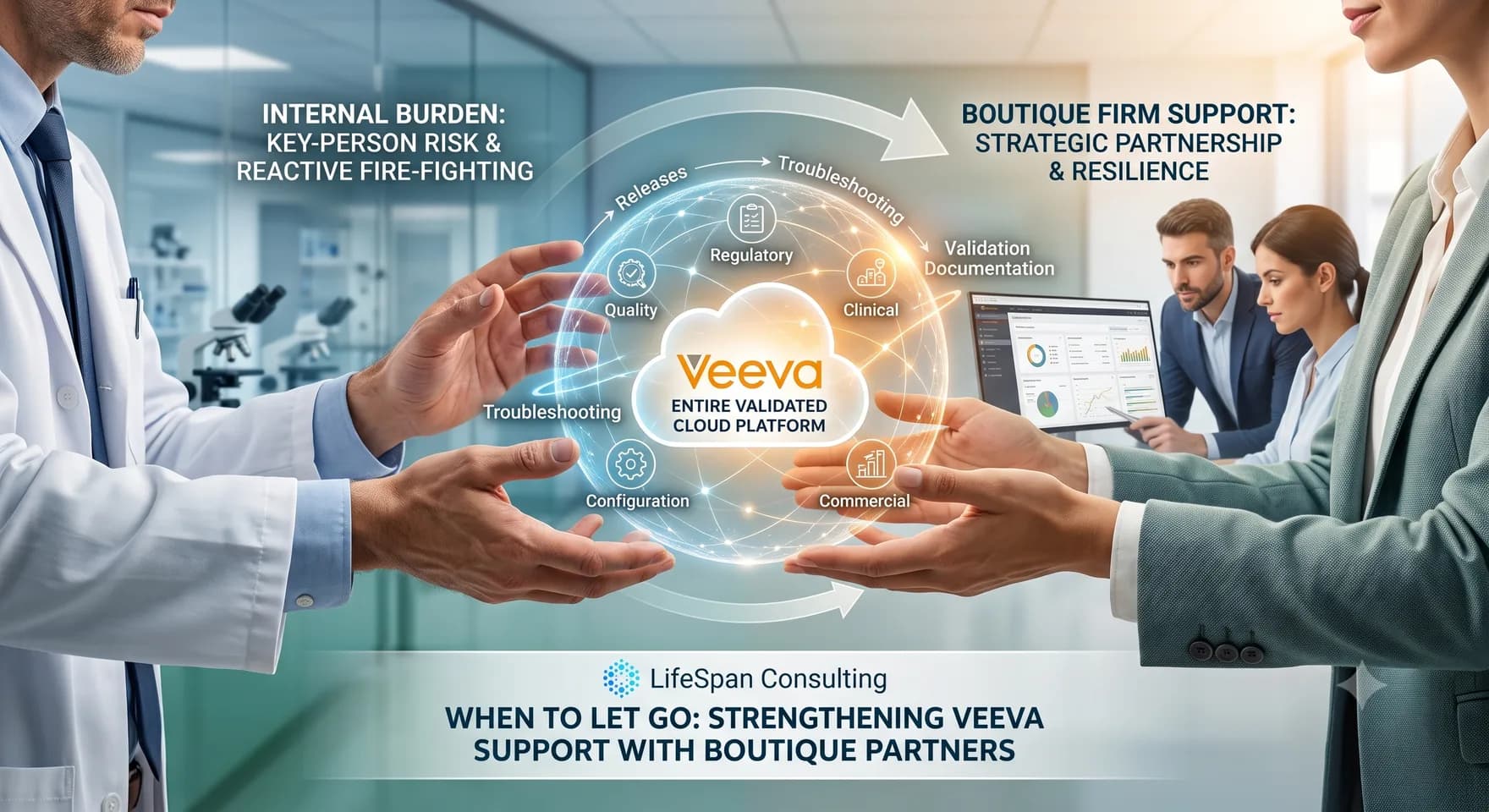
When to Let Go: Why Small and Midsized Life Science Companies Are Turning to Boutique Consulting Firms for Veeva Support
For small and midsized life science companies, Veeva has become the operational backbone — running Quality, Regulatory, Clinical, and Commercial processes on a single validated cloud platform. But there’s a quiet cost hiding behind that convenience: someone has to keep it running. Someone has to manage releases, troubleshoot configuration issues, provision users, maintain validation documentation, and answer the 4:45 PM Friday email about a broken workflow.
For many growing companies, that “someone” is one or two internal employees stretched across a platform that was built to support enterprises with dedicated IT and quality teams. It works until it doesn’t.
Supporting Veeva internally looks affordable on paper. In reality, it often means:
- Key-person risk. A single Veeva administrator or a two-person team becomes the only institutional knowledge of your validated environment. If that person leaves, takes extended leave, or is out sick during a critical release, support stops.
- Reactive, not strategic, support. Internal teams stretched thin tend to operate in break-fix mode, patching issues as they surface rather than proactively optimizing configuration, security profiles, or workflows.
- Release and validation burden. Veeva pushes regular platform releases that require impact assessments, regression testing, and validation documentation. For a lean internal team, this consumes a disproportionate share of available hours.
- Recruiting difficulty and cost. Experienced Veeva administrators are a narrow, in-demand talent pool. Fully loaded, a dedicated in-house Veeva admin or systems specialist commonly costs a company well into six figures annually in salary, benefits, and overhead before accounting for training, backup coverage, or turnover risk.
- Technical debt. Without ongoing governance, Vault environments tend to accumulate configuration sprawl, redundant workflows, and workarounds over time, making the system harder and more expensive to maintain the longer it goes unmanaged.
None of this shows up as a single line item — it shows up as slower resolution times, delayed releases, audit findings, and burnout on a team that never has room to get ahead of the work.
There’s rarely one dramatic moment that triggers the decision. It’s usually a combination of signals. Companies are typically ready to consider a boutique consulting partner when:
- You’re relying on one or two people for platform continuity. If your Veeva knowledge lives in one person’s head, that’s a business continuity risk, not just an IT staffing issue.
- Your team is spending more time firefighting than improving. If support tickets, release prep, and validation activities are consuming all available bandwidth, there’s no room left for optimization or strategic use of the platform.
- You’re scaling — adding modules, users, or business units. Growth events (a new Vault application, an acquisition, expansion into new markets) are natural inflection points where internal support models often break down.
- Turnover or a resignation just happened, or you’re worried it might. Losing your Veeva lead is one of the most common triggers for finally exploring outside support, but the smarter companies plan for this before it happens.
- You’re preparing for an inspection or audit. A validated, well-governed environment with clear documentation and change control history is far easier to defend under scrutiny, and expert support can help get there faster than an internal team working solo.
- Leadership is asking why Veeva initiatives take so long. If configuration changes, integrations, or new capabilities are taking months instead of weeks, it’s often a capacity problem, not a platform problem.
Large system integrators can absolutely support Veeva, but for small and midsized life science companies, boutique firms tend to offer a better fit for a few structural reasons:
- Senior-level attention, not a rotating bench. Boutique firms typically staff engagements with experienced consultants directly, rather than junior staff supervised by an offshore or overseas team. You’re more likely to work with the same people consistently.
- Flexible, right-sized engagement models. Boutique firms are generally more willing to scale support up or down as your needs change, rather than locking you into a large, fixed retainer built for enterprise-scale environments.
- Deep, focused expertise. A firm that specializes narrowly in Veeva (rather than offering it as one line item among dozens of enterprise software practices) often brings more current, hands-on platform knowledge.
- Faster decision-making and responsiveness. Smaller firms typically have shorter internal approval chains, meaning faster turnaround on both day-to-day support and strategic requests.
- Cost structure suited to your scale. Boutique consulting rates and engagement models are usually built with small and midsized companies in mind, rather than priced for enterprise budgets.
Companies that shift from internal-only support to a managed or co-managed Veeva support model with a specialized partner commonly report:
- Predictable, budgeted costs. Managed services engagements typically move Veeva support from a variable, headcount-driven cost to a predictable monthly or quarterly fee — easier to plan around and often lower than the fully loaded cost of additional internal hires.
- Faster issue resolution. With a dedicated multi-tier support structure (rather than a single generalist), routine issues get resolved faster, and complex configuration or integration problems get routed to specialists instead of stalling.
- Reduced key-person risk. Support continuity no longer depends on any one individual’s availability.
- Better release readiness. A structured, proactive approach to Veeva’s regular platform releases reduces the scramble and risk that comes with reactive, last-minute impact assessments.
- Freed-up internal capacity. Internal staff who were previously buried in day-to-day administration can shift toward higher-value work: process improvement, cross-functional projects, or platform strategy.
- Improved audit and inspection readiness. Better-governed configuration, cleaner documentation, and more disciplined change control make regulatory inspections less stressful and lower-risk.
- Access to broader expertise on demand. Instead of being limited to what one or two internal people know, you gain access to a team with cross-client experience across Quality, RIM, Clinical, and CRM modules.
While life sciences–specific, platform-level benchmarks are limited (most Veeva partners treat detailed metrics as proprietary), the broader outsourcing and managed services data provides a useful directional picture:
- Cost reductions of 20–70%. Organizations that outsource IT and administrative functions commonly report cost reductions in this range, depending on the function, delivery model, and geography, according to industry benchmarking compiled by Offshore247’s 2026 outsourcing report.
- Average realized savings around 9%. More conservatively, broader IT outsourcing benchmarks put average realized savings around 9%, against an average expected savings closer to 15%, a reminder that results vary by scope and execution, according to data cited in Clariontech’s 2026 IT outsourcing statistics report.
- More than half save above 20%. Among larger organizations with mature outsourcing or shared-services models, more than half achieve savings above 20%, per the Ataraxis Global Outsourcing Talent Index.
- Efficiency and speed gains up to 25%. Independent analysis has found outsourcing can improve operational efficiency by as much as 25% and can shorten time-to-market for supported initiatives by a similar margin, according to MyOutDesk’s 2026 outsourcing statistics compilation.
The takeaway isn’t a single universal percentage — it’s that across nearly every available benchmark, delegating specialized, intermittent-demand functions like Veeva administration to a focused outside partner tends to reduce cost relative to maintaining full in-house capacity, while also improving speed and consistency of support.
A well-run transition doesn’t mean an abrupt handoff. Most companies move through a phased approach:
- Assessment: a partner reviews your current Vault configuration, support volume, documentation, and pain points.
- Co-managed pilot: the boutique firm takes on a defined scope (e.g., Tier 1/Tier 2 support, or a single Vault application) while internal staff retain oversight.
- Knowledge transfer: documentation, configuration history, and institutional knowledge are captured and formalized rather than left in one person’s head.
- Full managed support: the partner assumes ongoing administration, release management, and optimization, with internal staff redirected to higher-value work or retained in an oversight capacity.
Veeva is too central to Quality, Regulatory, and Commercial operations to leave its ongoing health dependent on the bandwidth of one or two internal people. For small and midsized life science companies, the decision to bring in a boutique consulting partner isn’t about giving up control — it’s about gaining resilience, predictability, and expertise that would otherwise take years and significant cost to build internally.
The right time to explore this isn’t after a key employee resigns or an audit finding exposes a gap. It’s now, while you have the room to make a deliberate, well-planned transition instead of a reactive one.
Note: Cost-savings and efficiency figures above are drawn from general IT outsourcing and managed-services industry research, not Veeva-specific published benchmarks (which are largely proprietary to individual consulting firms). They are included as directional evidence of the value outsourcing models tend to deliver, and should be validated against your organization’s own cost structure before being used in external client-facing claims.
Sources: IntuitionLabs, “Veeva Managed Services | Application Management & Support”; USDM Life Sciences, “Veeva Partner”; fme US, “Post Implementation Managed Services for the Veeva Vault Platform”; Offshore247, “12 Outsourcing Cost Savings Statistics and Benchmarks” (2026); Clariontech, “Top Global IT Outsourcing Statistics and Trends in 2026”; Ataraxis, “100+ Outsourcing Statistics” and the Global Outsourcing Talent Index; MyOutDesk, “35 Outsourcing Statistics for 2026”; Sumatosoft, “Overview & Trends: IT Outsourcing in 2026”; Comparably, “Veeva Systems Systems Administrator Salary”.